Should You Trade the News? A Plain Answer With Data
Dylan Forexia7 min read
Should you trade the news? For most traders, not the release minute. On the markets we count, the jobs-report candle runs 6 to 10 times an ordinary 08:30 candle, fills are at their worst, and the first move did not settle the day on the days we studied. A fixed rule of ours around releases lost money after costs. That is the evidence, with its limits.
News trading means taking a position around a scheduled release, such as the US jobs report, inflation or a central bank's decision. The whole subject is mapped in news trading. All times here are New York and a candle is named by the time it opens.
Should you trade the news? The case for it
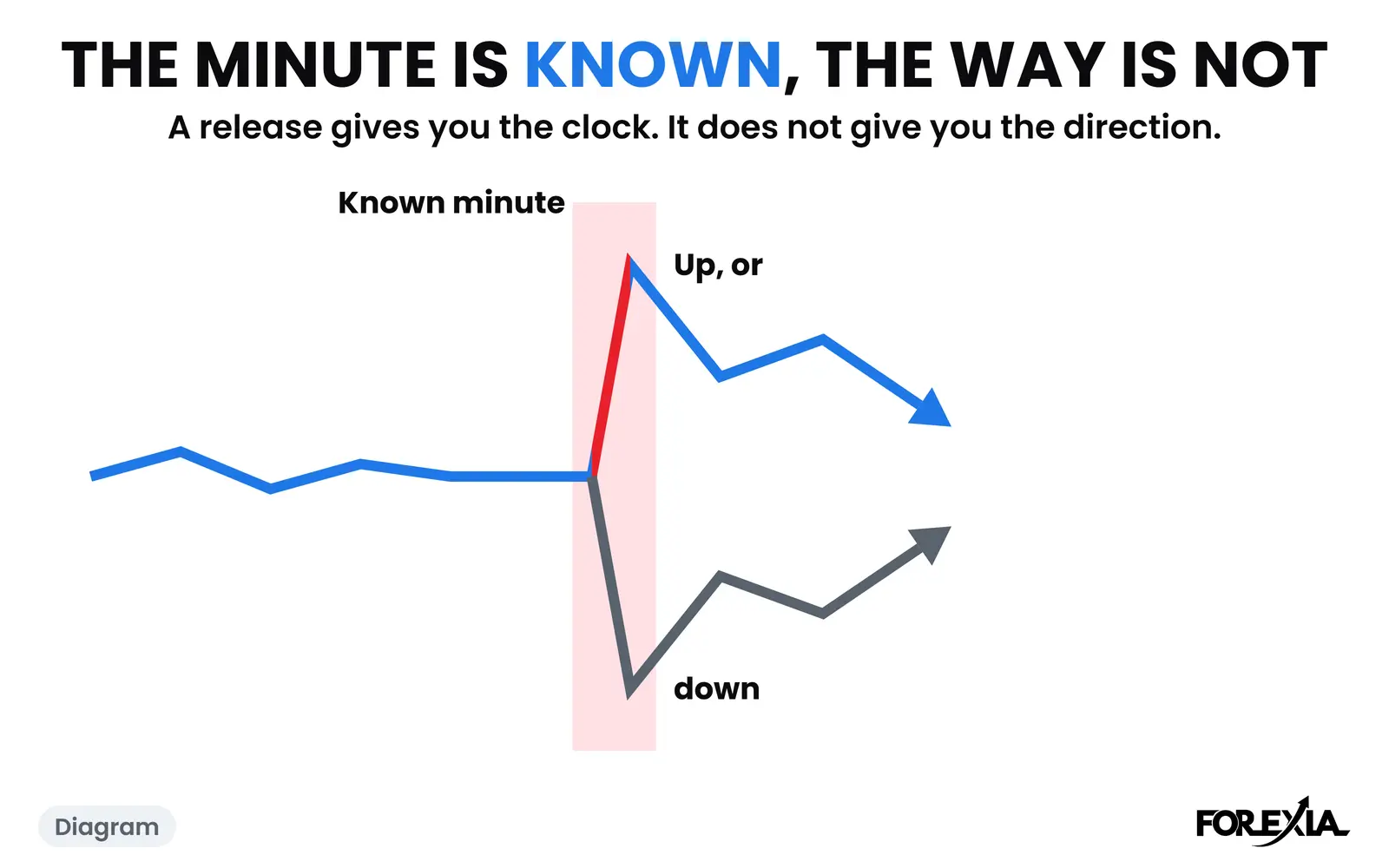
It is a real one, and it is size. A release gives price a known minute and a large move. The guides on this search offer three plans: be positioned before it, trade the first move, or wait for a pullback. All of them start from the same fact, that a release is the one minute of the week that everybody knows is coming.
The guides also agree that the risks run beside it: spikes that break a setup, fast reversals, wide spreads. Where they stop is the evidence. They quote no dated release and no test, and nearly all come from brokers, educators and forums with a reason to want you trading or not trading. The rest of this page is what we can count.
How big is the release minute?
Large, compared with the same time of day on an ordinary morning. We measured the 08:30 candle on the five jobs reports from 8 May to 4 September 2026, against the same candle on days with no high-impact US release at 08:30.
| Market | Median range on the five jobs reports (pips) | An ordinary 08:30 candle (pips) |
|---|---|---|
| EUR/USD | 41.3 | 6.7 |
| GBP/USD | 50.6 | 8.3 |
| USD/JPY | 73.8 | 7.6 |
| Gold | 62.0 | 10.7 |
On gold we count $1 as 1 pip. The average NFP move by pair has all eight markets and the report-by-report figures. The count is newsMoves in scripts/seo-counts.mjs. It is five reports on one feed, and these markets all move on the same dollar.
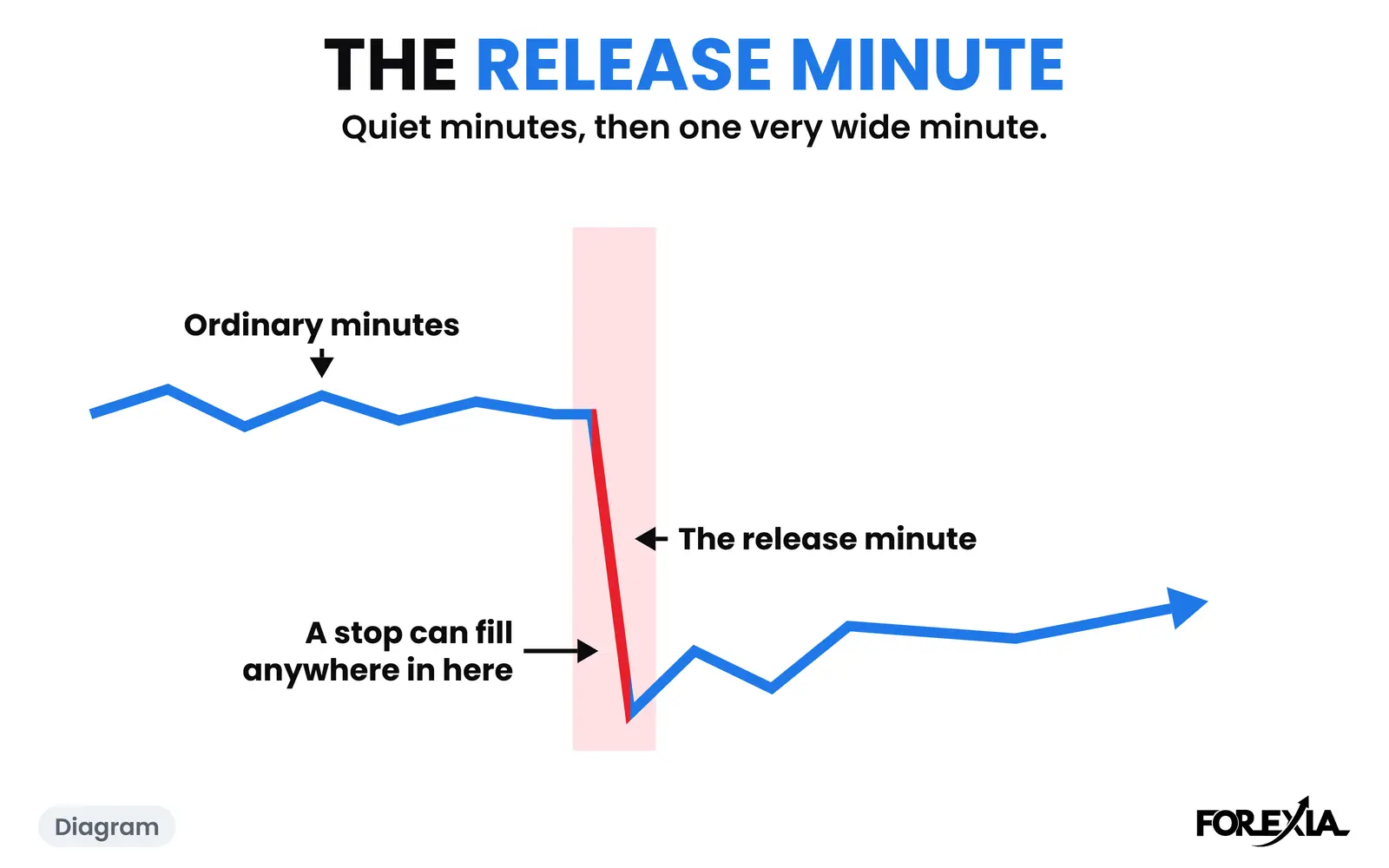
The size is the honest reason a person might want to trade it, and the same size is the reason a stop sized for a quiet morning does not mean what it says.
Does the release candle decide the day?
Sometimes, and not in a way that tells you which way. Across 30 mornings with a high-impact US item at 08:30, eight markets each, the 08:30 candle held the day's high or low on 43 of 240 market-days. On the 790 other market-days it held on 14. So the candle matters more than an ordinary one, and on 197 of those 240 market-days it still held neither end of the day.
Highs and lows both appear. A held candle tells you when to look and never which way, which is why NFP stop hunt goes report by report. It counts candles, not trades, on one feed, and the markets are not independent.
What happened on a real day? USD/CAD, 4 September 2026
One morning shows a reason to stand aside that has nothing to do with skill. Two currencies reported in one minute. At 08:30 the US jobs report and Canada's employment figures landed together, with earnings and the unemployment rates beside them. Earlier, at 04:50, the Bank of England's governor had spoken.
Everything before 08:30 was quiet. From the London open at 03:00 to 08:29 USD/CAD traded between 1.37898 and 1.38088, a 19-pip morning. The 08:30 candle opened at 1.37912, ran to 1.38716, 81 pips, and closed at 1.38629. That is more than four times the whole morning before it, in one candle.
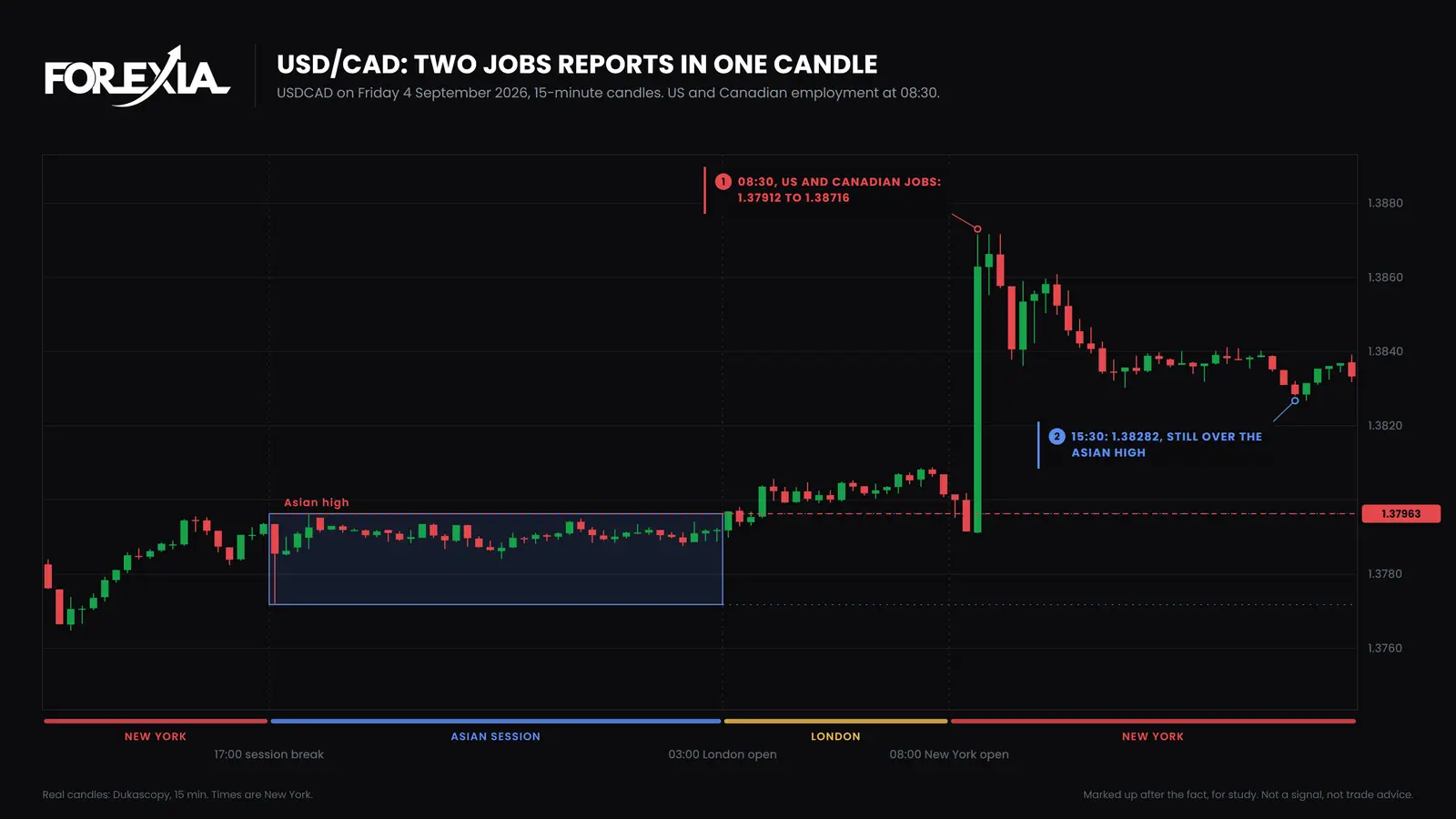
The pair gave back some of it. The 09:15 candle closed at 1.38406, and the post-release low of 1.38268 came on the 15:45 candle, 45 pips under the day's high of 1.38717 and more than 30 over the Asian high. Nothing traded back under 1.37963 that day.
What no chart can tell you is which report did it. USD/CAD moves on either, and no reading of that candle can say how much was the dollar and how much was the Canadian dollar. That is a limit of the instrument, not of the reader.
What did our own test find?
It lost. A program we wrote flagged each hunt as it happened on seven dollar majors and gold, on 5-minute Dukascopy candles with real bid and ask, from February 2021 to December 2024. Costs were the real spread plus 0.7 to 0.8 pips a round trip for commission and slippage ($0.15 on gold). R is the amount risked on one trade.
Fading hunts printed in the release candle came to -0.12R a trade over 1,037 trades, against -0.16R on all hunts and -0.17R on hunts with no release within six hours. The release helped the rule, a little, and it still lost. Fills had the real spread and no extra slippage, so real fills would be worse.
It is one rule on one data source and says nothing about a trader reading the chart. It does say a release is not an edge by itself. The stop hunt hub carries the wider test.
When should you stay out of the news?
When the answer to any of these is no. Can you say how far from its price your stop could fill if the minute ranged 40 or 80 pips? Do you know which currencies report in that minute, as USD/CAD did on 4 September? Can you accept a loss larger than the distance on your chart? A stop is a market order once it triggers, and NFP spreads and slippage measures how far one minute travels.
If the answer is yes, the plan is yours to make, and the release is still not a signal. A day picked afterwards flatters any read, and a reversal seen afterwards is not a setup.
The same question applies to every central bank: the ECB has its own morning. Forex news manipulation takes up whether the move is aimed at anyone.
Is it better to trade after the news instead?
It removes one problem and leaves another. After the first minutes the spread has narrowed, so the fill is closer to the price on the screen. The first move may be gone, and it may not have been the real one.
Two jobs mornings gave some of it back. EUR/USD on 2 July ran 73 pips in the jobs candle and was 39 pips under the day's high by the 10:30 candle. USD/CAD on 4 September was 45 pips under its high at 15:45. Neither retraced to where it began, so waiting for a pullback would have meant waiting through a move that kept going. We have no test showing that waiting pays, and the guides that say it does show none either.
The honest summary is that a release gives you a very large candle and no way to know its direction in advance. Whether that is worth your attention depends on what you can show, and so far we can show very little in favour.
What does each seat see?
The Three Seats split the minute.
- Retail sees a number to forecast. The quiet hours before it, the Window of Tolerance, look like a setup waiting for a catalyst.
- The market maker, as we read it, sees a known minute and orders waiting past levels. That is News-Induced Liquidity. Nobody outside can see those orders.
- The observer sees a size and a count. The candle was large and decided the day on one market-day in six. That says nothing about direction.
Course 2 of ForexiaPRO, The Chaos Pattern, teaches this read step by step in lesson 2.3.3, NFP, CPI, FOMC: One Read, Three Calendars.
Frequently asked questions
Should beginners trade the news?
We would not, and our data gives no reason to. The release minute runs 6 to 10 times an ordinary 08:30 candle on the markets we count, fills are at their worst, and the first move did not settle the day on the days we studied. Learning to read an ordinary morning comes first.
Is news trading profitable?
We cannot show that it is. Our own fixed rule of fading hunts printed on a high-impact release came to -0.12R a trade after costs, from February 2021 to December 2024. It is one rule and says nothing about a person reading the chart, but a release is not an edge by itself.
When should you stay out of the news?
When you cannot say how far from its price a stop could fill, and when two currencies report in the same minute. On 4 September 2026 US and Canadian jobs came at 08:30 and USD/CAD ran 81 pips in a candle, more than four times the whole morning before it.
Is it safer to trade after the news?
The spread narrows, but the first move may be gone and may not be the real one. On 2 July 2026 EUR/USD gave back 39 pips from its high by the 10:30 candle, and on 4 September USD/CAD gave back 45 by 15:45. We have no test showing waiting pays.