Pin Bar vs Engulfing Candle: We Tested Both on 15,978 New Lows and Highs
Dylan Forexia6 min read
Pin bar vs engulfing candle is a question every candlestick guide answers by describing the shapes, and none by counting them. We counted. On seven dollar majors and gold, 771 pin bars and 1,721 engulfing candles at new lows and highs went no further than any other candle that made a new low or high. Neither shape beat the plain extreme.
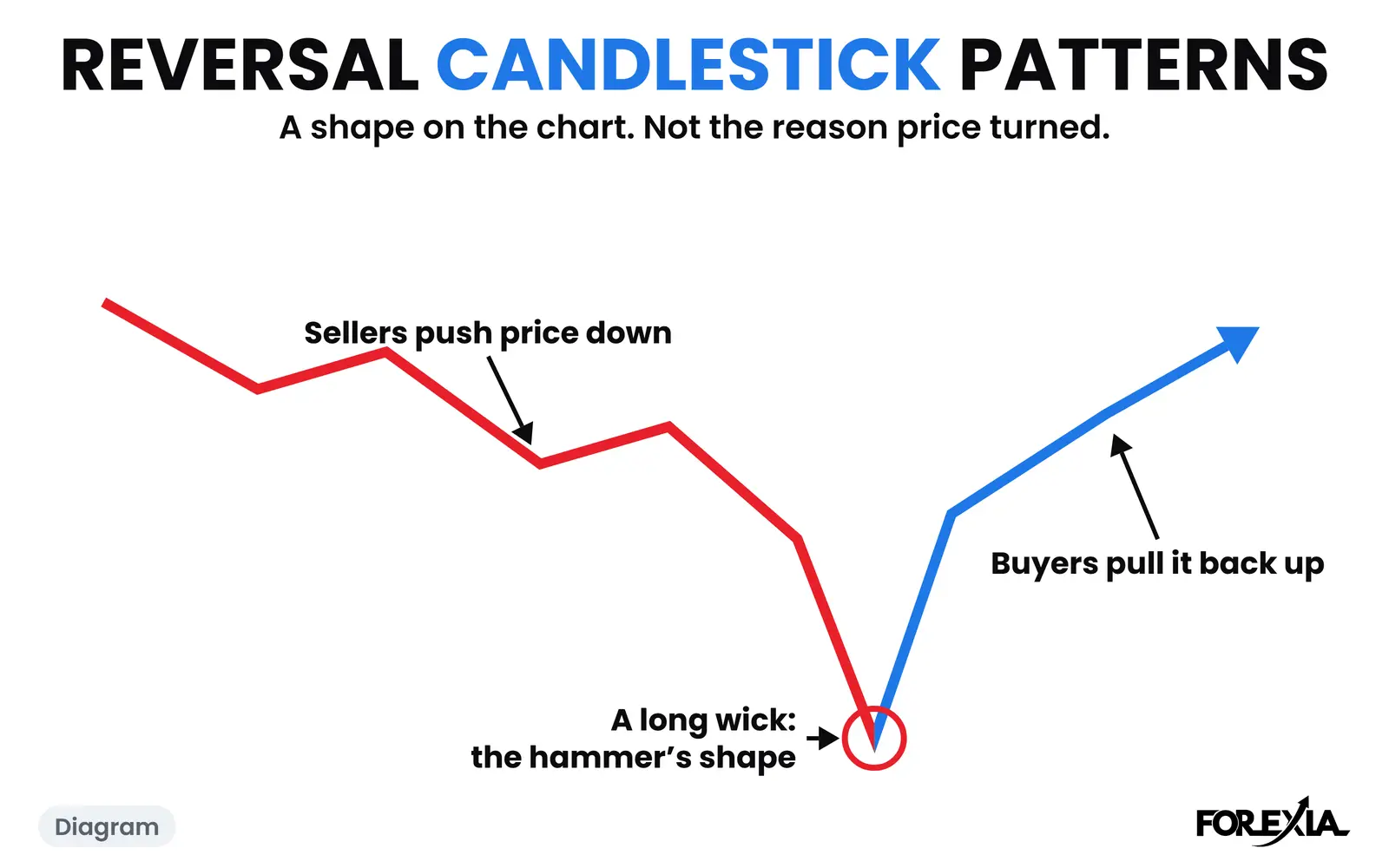
The shapes are in the guide to reversal candlestick patterns, with a pin bar and an engulfing candle each on a small drawing. This page is the head-to-head, and it is the count the guides leave out. It sits within our guide to price action.
Pin bar vs engulfing candle: what is each?
A pin bar is one candle with a long wick and a small body at the far end. At the bottom of a fall it is a hammer, and at the top of a rise a shooting star. The long wick is the story: price went there and was refused.
An engulfing candle is two candles. The second one's body covers the body of the first, and it goes the other way. The story is the second candle taking back what the first one gave.
The books rate the engulfing candle higher, because it asks for more before it shows. That makes it rarer. It does not make it right more often, and no page we read gave a count to say so.
How did we test a pin bar vs an engulfing candle?
The test needs a yardstick, and pattern lists never give one. Price turns after a lot of candles, so a shape has to be compared with a plain candle at the same place.
- The place. Every 15-minute candle from the London open to an hour before 17:00 New York whose low is the lowest of the 12 candles before it, read as if it marked a turn up. The same count was run for highs.
- A pin bar. A candle at that place at least as big as the median of the 20 candles before it, with a lower wick of at least two thirds of its range.
- An engulfing candle. An up candle whose body covers the body of the down candle before it, where either candle made the 12-candle low.
- The question. Did the close four candles later, an hour on, stand further the shape's way than this candle's close?
The sample is 6 April to 1 October 2026, Dukascopy candles, 1,030 market-days. It has no entry, no stop and no cost, so it counts candles and not trades.
What did the pin bar and the engulfing candle do?
Nothing the plain candle did not. The table gives each shape against the yardstick, which is every candle that made a new 12-candle low or high, whatever its shape.
| Candle | How many | Close further that way an hour later | Median move after an hour, share of the daily range | Median move by 17:00 |
|---|---|---|---|---|
| Any new 12-candle low or high (the yardstick) | 15,978 | 51.8% | +0.5% | +1.1% |
| Pin bar at a new low or high | 771 | 51.5% | +0.5% | -2.7% |
| Engulfing candle at a new low or high | 1,721 | 50.0% | 0.0% | +0.4% |
| First candle past a level, closed back inside it | 392 | 47.2% | -1.0% | -2.2% |
Read each row against the first. The yardstick is close to a coin, and the two shapes are on it: 51.5% for the pin bar and 50.0% for the engulfing candle. By 17:00 the median pin bar had moved 2.7% of a daily range against its direction, and the engulfing candle 0.4% with it. Those are small moves on either side of zero.
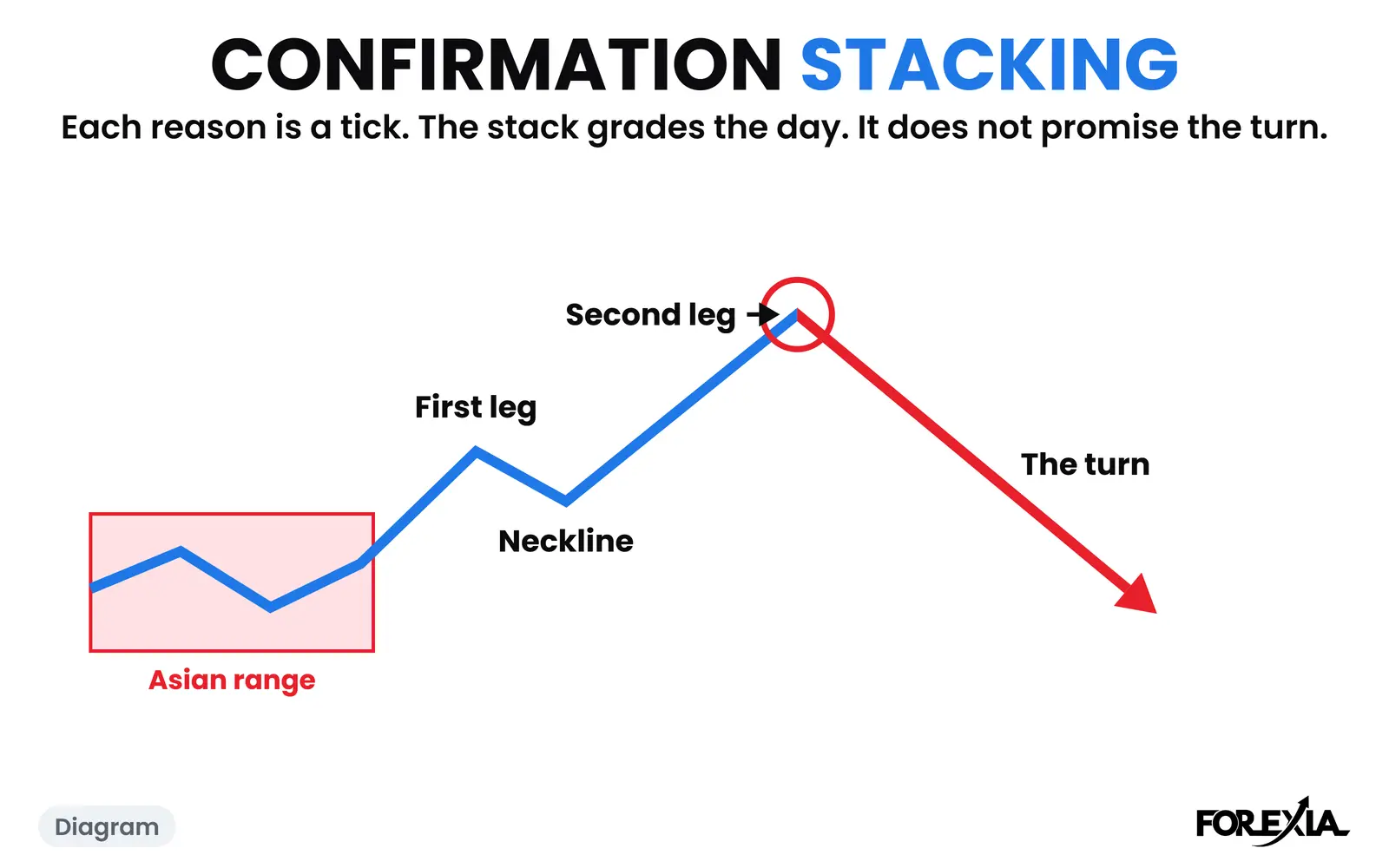
The last row is a place and not a shape. It is the first candle of the day to trade past an edge of the Asian Box or the previous day's high or low by at least 3% of the average daily range, and close back inside it. It did slightly worse than the yardstick. Place alone did not rescue it.
Why did neither shape beat a plain new low?
We read it from the other side. A pin bar at a new low is a long wick under a level a crowd can see. Sellers who sold the break are stopped by the wick, and buyers who bought the dip get in on it. A candle that did that has already done its job by the time it closes. What comes after depends on the next orders, not the shape of the last candle.
An engulfing candle is two candles of the same story: first a push, then a reversal. By the time its second body closes, the move it covers is over, and a trader who acts on it is acting on a closed candle. That is a reading, not something the table proves.
One point decides a trade more than the shape: the stop. Everyone reading the same shape puts it in the same place, just past the wick or the pattern, and a quick candle can reach that row of orders. Why stop losses sit above highs explains how that happens.
A real day of pin bars: USD/JPY on 3 September 2026
On Thursday 3 September 2026 the yen was falling. Pin bars formed at 05:45, with a low of 156.196, at 06:00, with a low of 156.173, and at 07:15, with a low of 155.839. Each was at a new low, and each was traded through. The low of the day was 155.299 at 12:45, 80 pips under the third pin bar's close.
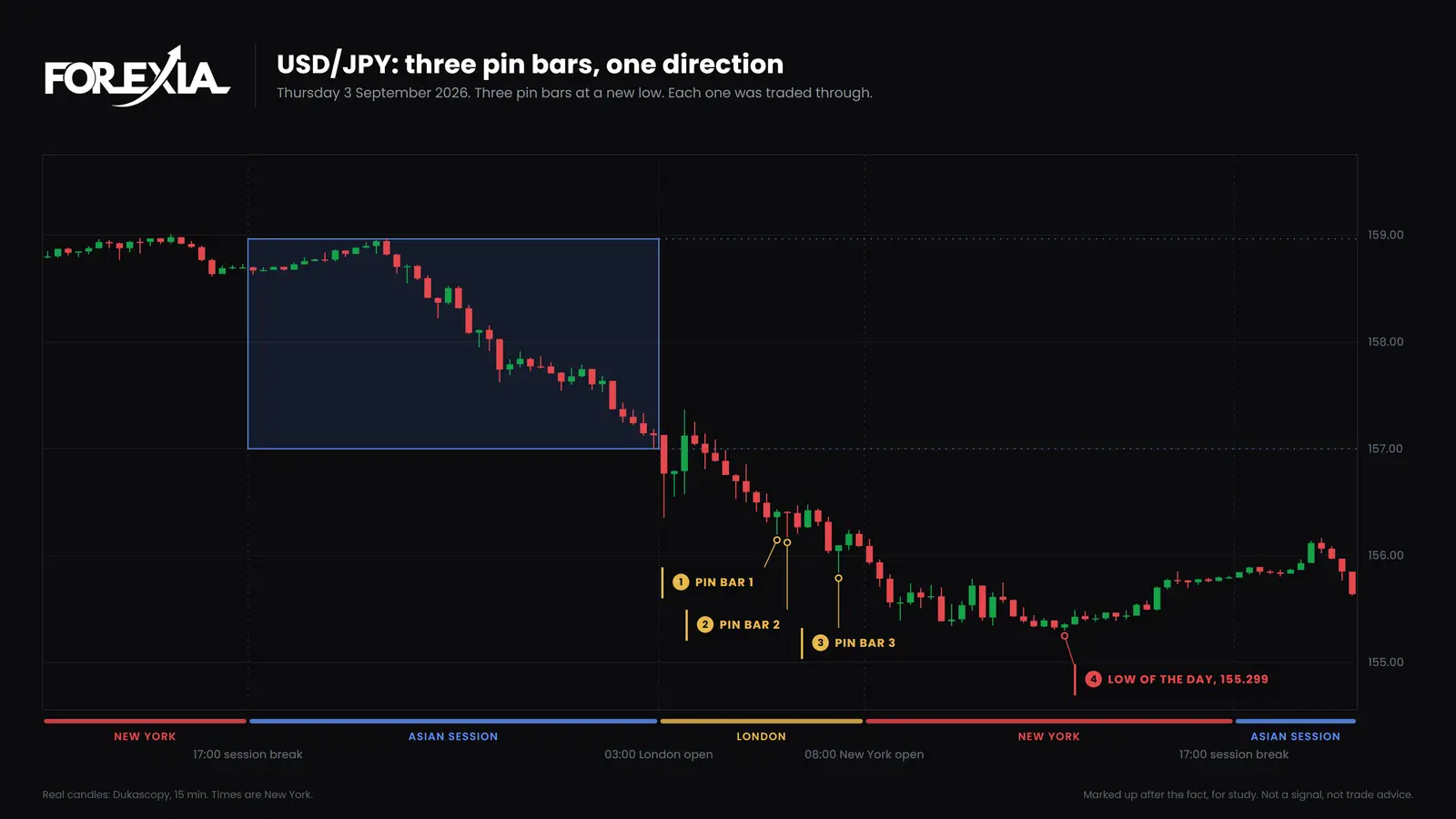
Anyone who bought the first pin bar with a stop under its wick had that stop taken by the next one. We chose this day because it shows the point, so it proves nothing by itself. The table is the evidence, and it is a count of candles with no cost in it. There is no dated engulfing candle on our site yet, so this page does not show one.
What would a fair test of a candle shape need?
Three things, and the guides we read had none of them. A yardstick, so the shape is compared with the plain candle at the same place. A rule written before the result, so the shape is not redefined until it works. And the days it did not work on, listed with the days it did. Our table has the first two. It has no list of costs, so it cannot say what a trader would have kept, and a count like this can only ever say that a shape did not stand out.
That is also why we do not rank the six shapes in the catalogue. We tested two of them, and neither stood out.
How is this different from The Reversal Candle?
The Reversal Candle is our word, and it is defined by place, not by shape. It is one huge candle through the stops straight after the crowd gets in. It may have a long wick, or none. The pin bar and engulfing tests above are not a count of it, because they ask nothing about size against the crowd or about what came just before.
What do traders get wrong about the two shapes?
Three readings cost the most.
- Rating a shape by how rare it is. An engulfing candle is rarer because it needs two candles. Rarer is not more reliable.
- Reading a shape as a signal. A reversal seen afterwards is not a setup. Our own test of the setup as a mechanical rule did not make money, and nothing here changes that.
- Trusting the picked day. Every chart on this page was chosen after the move. The count is the part that was not.
Course 3 of ForexiaPRO, Reverse Price Action, teaches how to read a candle from the stops it leaves, step by step. It is on ForexiaPRO.
Tools for this
Frequently asked questions
Is a pin bar better than an engulfing candle?
Not on our test. We took every 15-minute candle from the London open that made a new low or high against the 12 candles before it, on seven dollar majors and gold, 6 April to 1 October 2026. A close an hour later stood further the shape's way after 51.5% of 771 pin bars and 50.0% of 1,721 engulfing candles, against 51.8% of all 15,978 new extremes. Neither beat the plain new extreme.
Does a pin bar work at support and resistance?
We tested one kind of place, the first candle of the day to trade past an edge of the Asian range or the previous day's high or low and close back inside it. It came to 392 candles, and 47.2% of them stood further the right way an hour on. That is a count of candles with no entry or cost, and it is slightly under the plain new extreme.
What is the difference between a pin bar and a hammer?
The shape is the same: a small body at one end and a long wick the other way. A hammer is the name in books for it at the bottom of a fall, and a shooting star at the top of a rise. Pin bar is the price action traders' word. We count them together under one rule.
What is The Reversal Candle, and how does it differ?
It is our word for one huge candle that goes through the crowd's stops straight after the crowd gets in. It is defined by where and when it printed, not by its shape, so the pin bar and engulfing tests above are not a count of it.