Why Does Price Consolidate on Wednesday Before Reversing?
Dylan Forexia6 min read
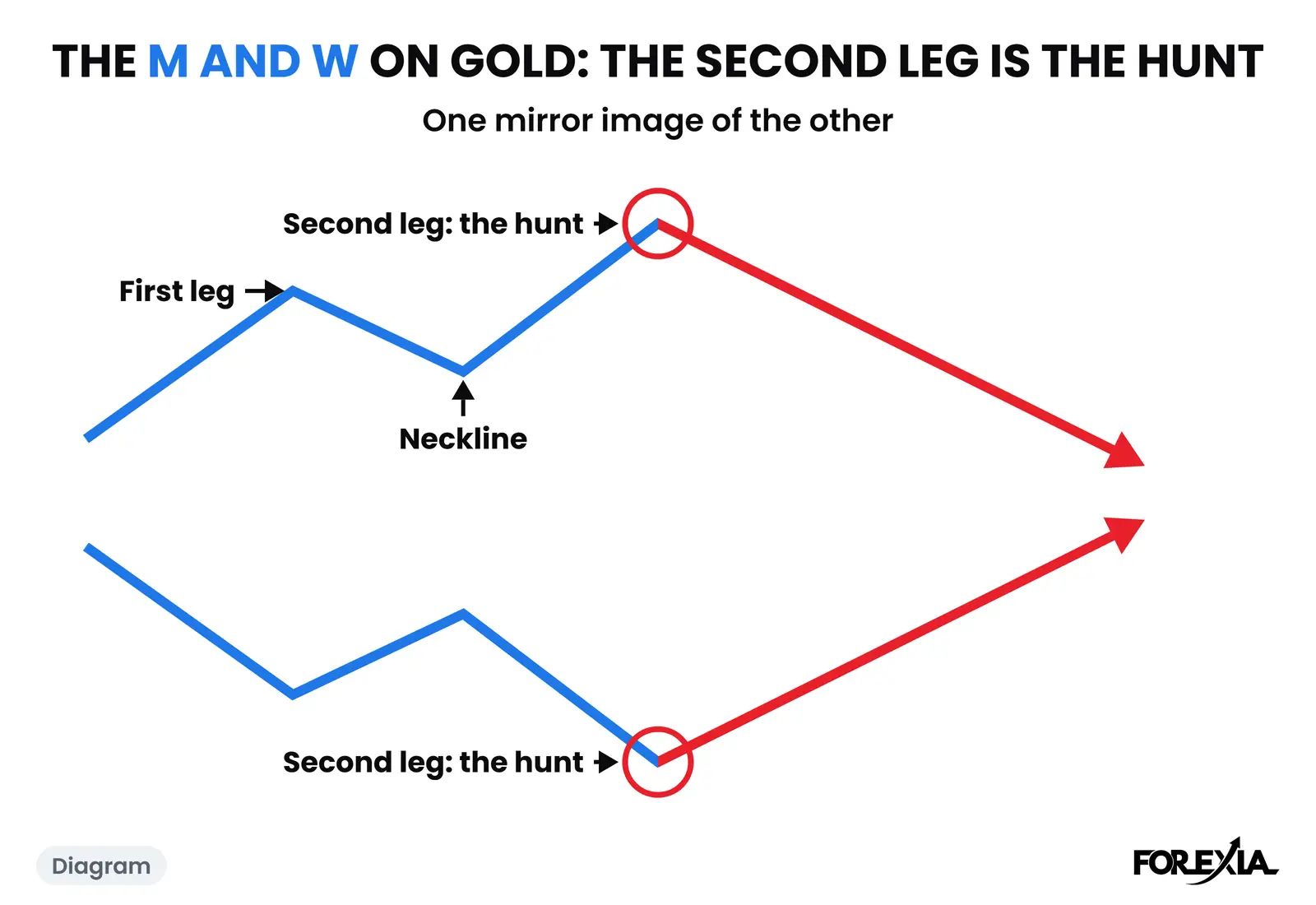
Why price consolidates on Wednesday before reversing is a fair question. Sometimes it does, and it is not a rule. On USD/JPY in the week of 6 July 2026 price went quiet on both sides of its high, and our reading is that quiet hours let orders build before a run through one side. We call the shape the Midweek Trap: a multi-day, multi-session M.
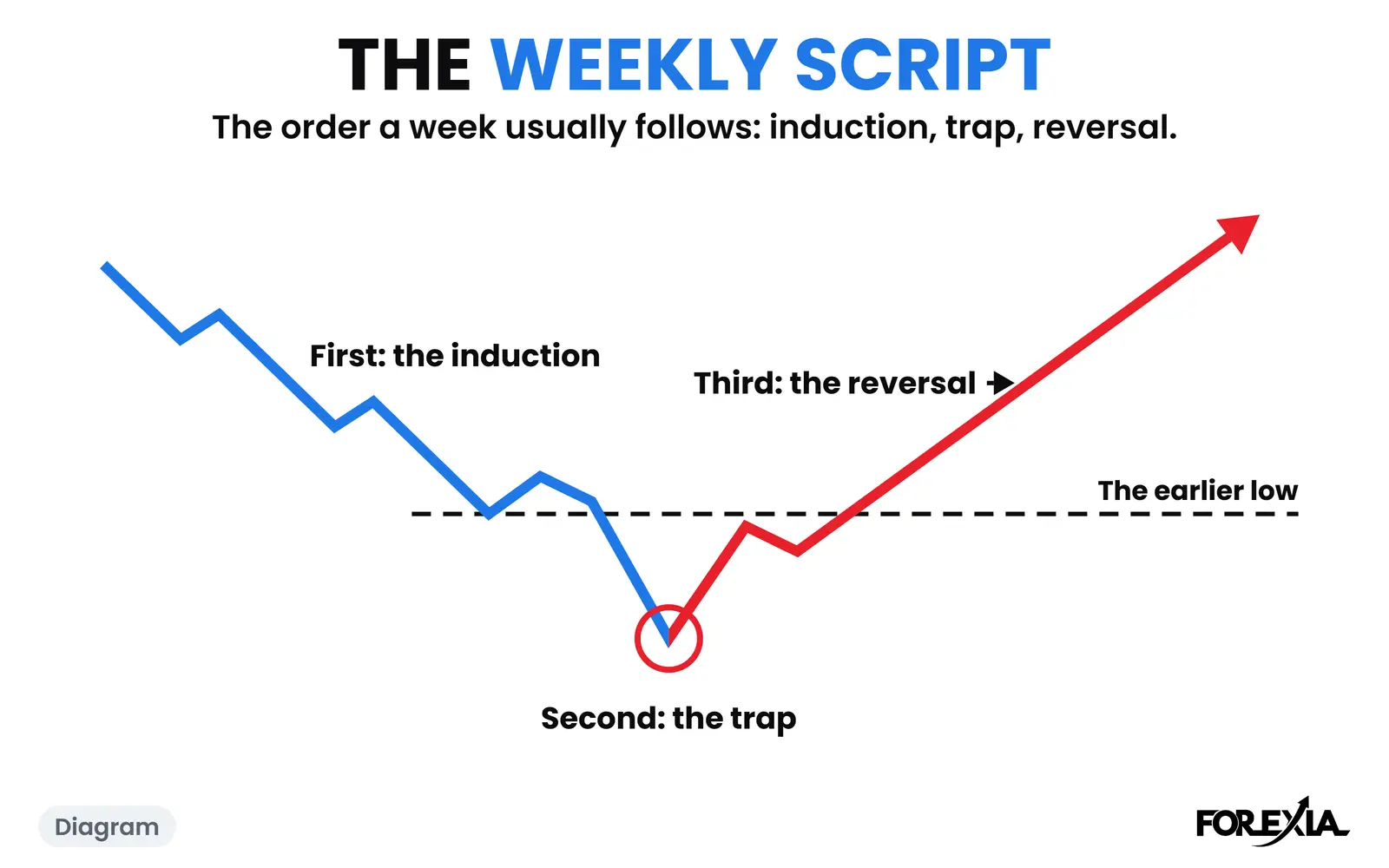
This page reads that week, then looks at weeks where price did not go quiet. It is the question about the pause, and how to spot a mid-week reversal takes the turn that follows. Both sit in the weekly cycle.
What does the Midweek Trap look like on a real week?
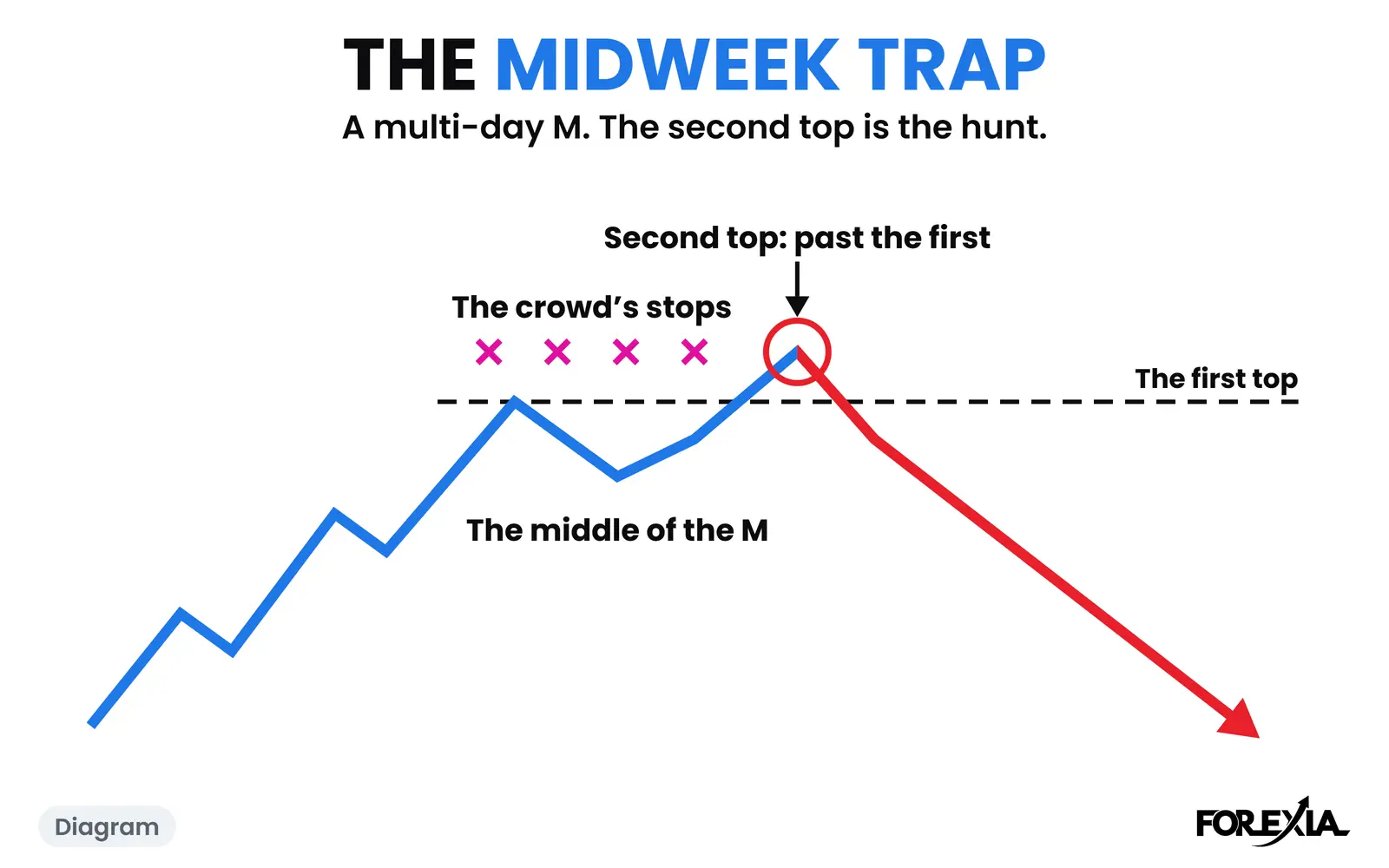
It looks like a breakout that has been waiting for you. USD/JPY opened the week of 6 July 2026 at 161.271. Monday ran up 80 pips on the day, with a high of 162.425 at 08:45 New York. That is the first top of the M.
Tuesday did very little. It dipped to 161.659, recovered and closed at 162.090, 2 pips up on the day. That dip is the middle of the M. At 11:30 on Wednesday price reached 162.708, the high of the week, 28 pips over Monday's high. That is a stop hunt, what most traders call a liquidity sweep, and the second top. By then the rise had covered 145 pips from Monday's low in three days. Anyone reading the chart for a trend saw a fresh high.
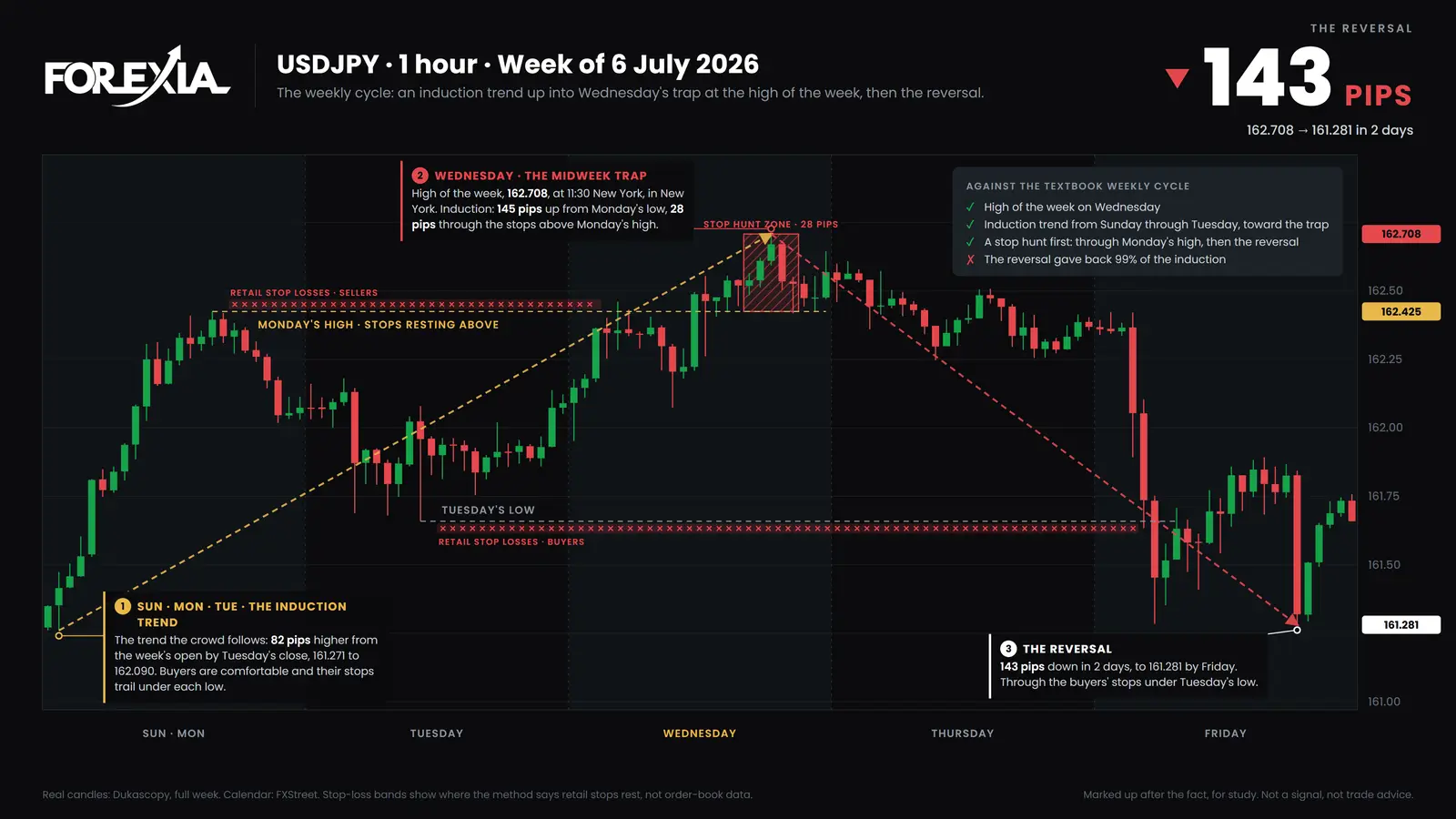
Then nothing happened for a long time. The 20:00 candle on Wednesday night closed back under Monday's high at 162.400, and the first hourly close under it was the 01:00 hour. Thursday's session stayed inside 36 pips. Tuesday's low did not go until 21:15 on Thursday night, nearly a day and a half after the high. By 11:45 on Friday price was at 161.281, 143 pips off the top.
How quiet was it, and where?
It went quiet twice. Tuesday stayed inside 52 pips before the hunt, and Thursday inside 36 after it, against 116 on Monday. Those are the numbers behind "consolidation", and they are small beside the run that followed.
AUD/USD in the week of 27 July 2026 offers a second picture. Price spent the three hours before the Fed's decision on Wednesday inside 13 pips. That pause came just before a scheduled release, so a pause can have an obvious reason as well as a hidden one.
Why does price consolidate on Wednesday before reversing, if it does?
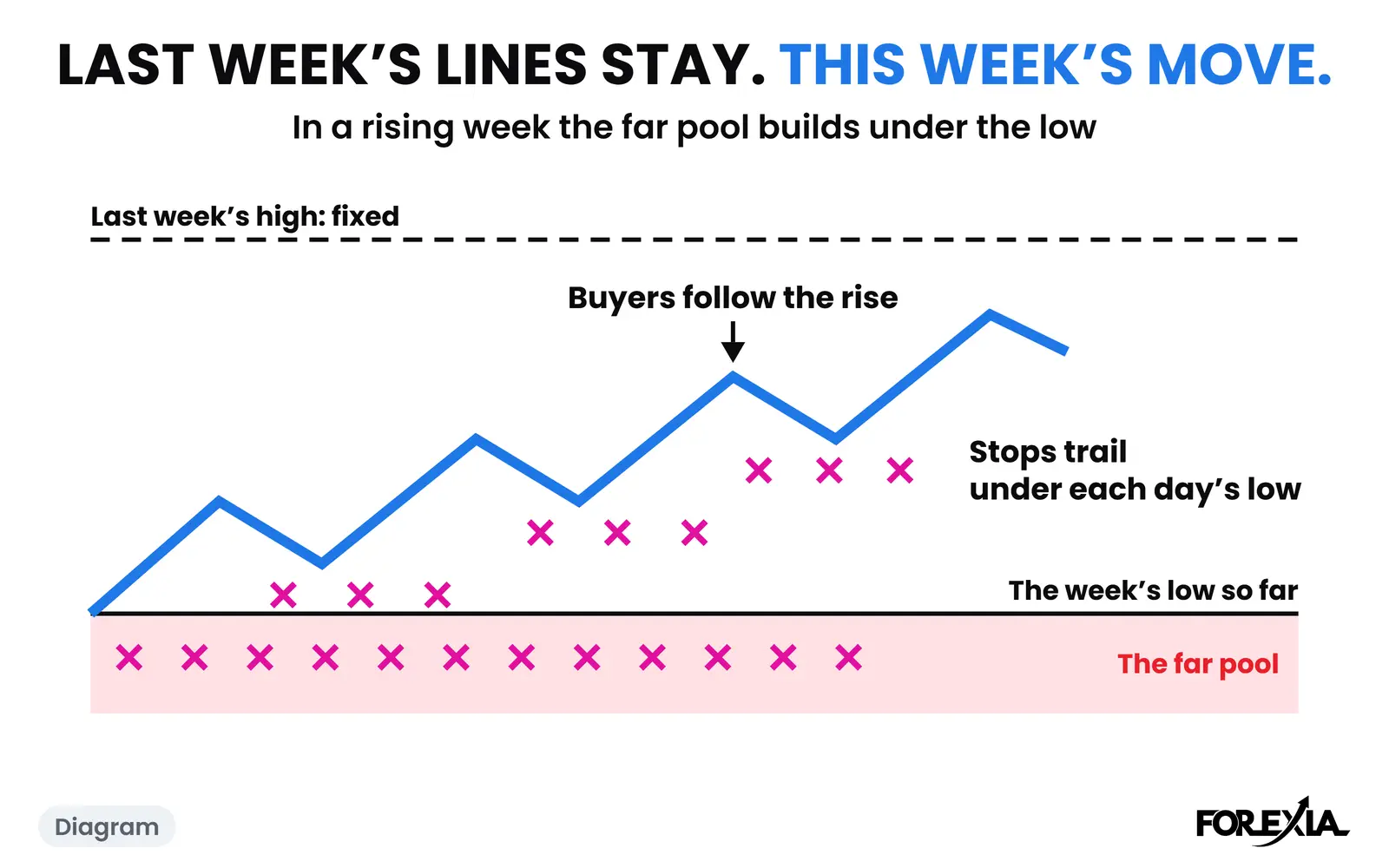
We have a reading, and no proof. Quiet hours let orders build on both sides, on our reading: breakout buyers above the high, and stops under the lows. No public book shows forex stops, because spot forex trades over the counter, so we cannot show that the pause did anything. It may also be plain: Tuesday often has little scheduled, and the market waits for Wednesday's data and central bank decisions. On the AUD/USD week the Fed came at 14:00 on Wednesday, and on the USD/JPY week Wednesday's high came at 11:30.
The Three Seats read the pause differently.
Retail's seat
Retail reads a pause under a high as consolidation before a breakout. A tight range after a rise looks like the trend taking a breath, and the next high looks like confirmation.
The market maker's seat
On our reading the market maker sees the orders that have built up above Monday's high, and the second top is how they are filled. We cannot show that anyone plans this.
The observer's seat
The observer sees two tops and a quiet middle and waits for a close. On USD/JPY the chart showed a breakout until the 20:00 candle on Wednesday closed back under Monday's high. A week can stay a breakout, so the word names something you can only be sure of afterwards.
How can you measure the quiet on your own chart?
Measure it in ranges, not in feel. Take the high-to-low range of each day of the week so far, from the 17:00 New York break to the next, and put them side by side. On USD/JPY that week they ran 116 pips on Monday, 52 before the hunt on Tuesday and 36 on Thursday. A day well under the one before it is quiet. A day over it is not, and on a week where Wednesday carries a major release it will not be.
Then ask what the quiet sits beside. Quiet under a level the crowd can see, as under Monday's high here, is the picture the Midweek Trap describes. Quiet in the middle of a range, with no level near, is just quiet. The measure says how little happened. It does not say why, and it does not say that a turn is coming. Keep the numbers with the week they came from: 52 pips is quiet for USD/JPY and not for a pair that normally moves far less. The forex average range by weekday page shows how different each market's normal day is, and why a figure has to be read against its own market.
Does price always go quiet before the turn?
No, and that is why we do not state it as a rule. On USD/CHF in the week of 28 September 2026 Wednesday closed near its high at 0.83616 and the trap came on Thursday at 02:30. On USD/CAD in the week of 21 September 2026 price edged over Tuesday's high on Wednesday, by about a pip at first and never by more than 10, and then rose for two more days. That looked like a trap and was not one. No quiet period tells you which of those weeks you are in.
Two weeks are not a count, and we have not made a count of consolidation before turns. Wednesday in the name is the usual place, not a date, and the Mid-Week Reversal is the turn itself, which can land a day either side.
What do traders get wrong about the Midweek Trap?
Three readings cost the most.
- Reading the second top as confirmation. At 11:30 on Wednesday the chart showed a higher high, and that was the week's last one.
- Expecting a fast turn. The fall through Tuesday's low took nearly a day and a half to start. A close back is not a clock.
- Calling every midweek high a trap. A week can keep rising into Friday. A reversal seen afterwards is not a setup, and our own test of the daily setup as a mechanical rule did not make money.
The Signature Trade is a different, daily version of the same idea. The Midweek Trap stretches across days and sessions, while the daily M and W reversals are built inside one day from a clear Asian range.
Sources
The USD/JPY week of 6 July 2026 and the AUD/USD week of 27 July 2026 are read from our chart write-ups, on Dukascopy candles in New York time. The Fed's 14:00 decision time is on its meeting calendar.
Course 4 of ForexiaPRO, The Week, in production, teaches the Midweek Trap in lesson 4.3.1.
For study only. This page is not a signal and not trade advice. Charts are Dukascopy candles, marked up after the fact.
Frequently asked questions
Why does price consolidate on Wednesday before reversing?
Sometimes it does and sometimes it does not, and we state it as no rule. Our reading is that quiet hours let orders build on both sides, breakout buyers above and stops under the lows, before a run through one side. No public book shows forex stops, so that cannot be proved.
What is the Midweek Trap?
It is Wednesday's trap, a multi-day, multi-session M: the last push of a rising week, run past an earlier day's high. It looks like the moment the trend is confirmed. Trap is our reading of what the shape does to the people who trust it.
Does every Wednesday go quiet before the turn?
No. On USD/CHF in the week of 28 September 2026 Wednesday closed near its high and the trap came on Thursday, and USD/CAD in the week of 21 September never turned at all. Two or three weeks are not a count.