Gold Stop Hunt at the New York Open: Seven Real XAUUSD Days
Dylan Forexia8 min read
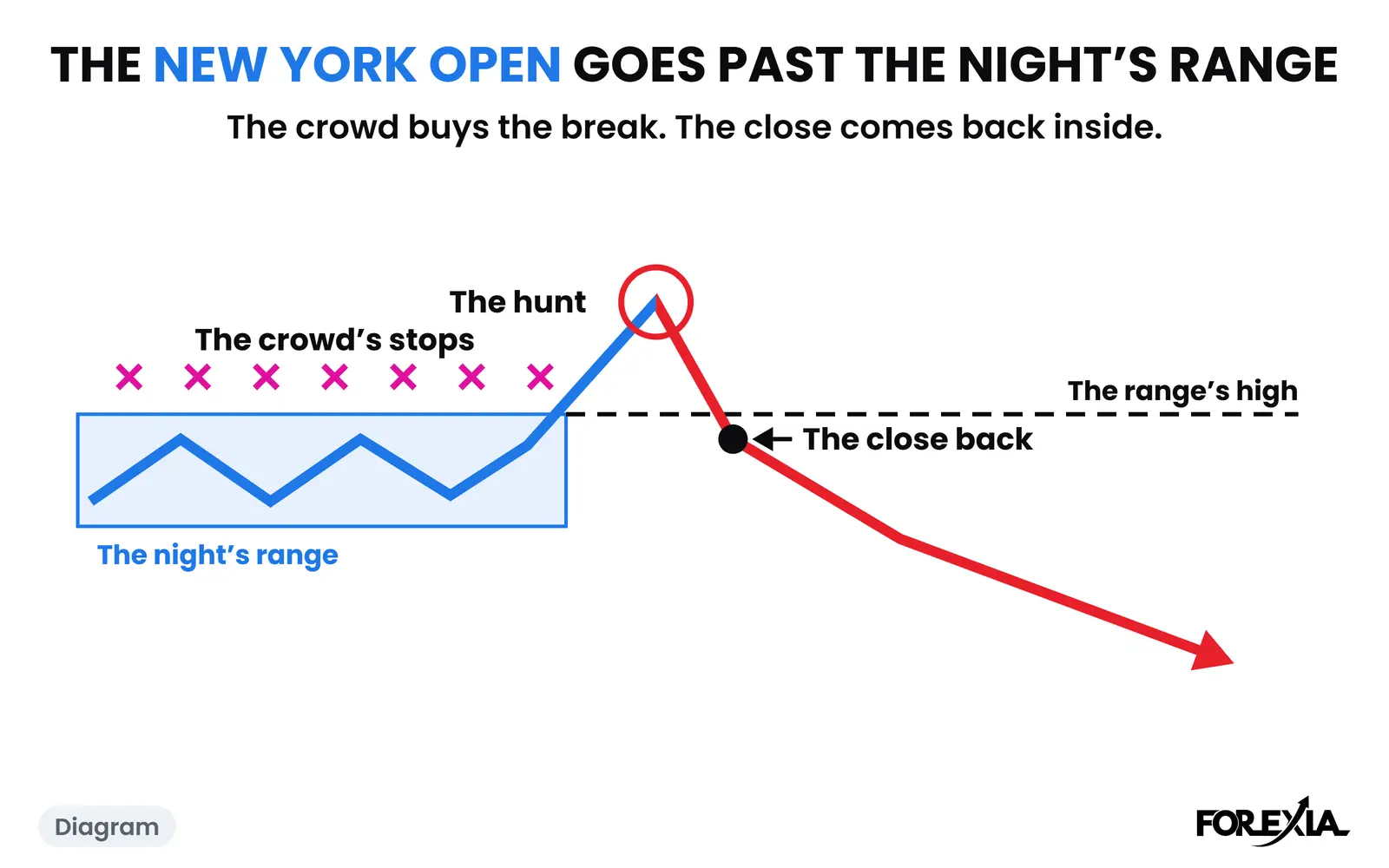
The gold stop hunt New York open is a push past the Asian range in the first hours of the New York session, followed by a close back inside it. Across seven marked-up XAUUSD days in 2026 the extreme printed between 08:00 and 10:15 New York time, past a night range of 38 to 59 pips, and gold then ran 47 to 186 pips the other way. Five of the seven cleared the whole night range, and two stopped inside it.
These days were marked up afterwards, for study. None is a signal, and a reversal seen afterwards is not a setup. On gold we count $1 as 1 pip, and all times are New York. For the whole picture, start with how to trade gold.
Why does gold hunt stops at the New York open?
Because the night leaves an obvious range, and the New York session is when it gets tested. The Asian session, from the 17:00 session break to 03:00, builds a box that traders mark with a support and a resistance, and park their stops either side. The Asian Box is our word for it. We read the push past it as the stop hunt, which most traders call a liquidity sweep: orders that were waiting past the level fill the other side of a large order, and price comes back.
That is our reading, and the stop orders are not in any data we hold. What the data does show is when. Across 2021 to 2026, 67% of gold's hunts printed in New York, and the busiest hours were 08:00 (22%), 09:00 (21%) and 10:00 (14%). Gold's hunts are mostly a New York matter.
What did seven New York hunts on gold look like?
Seven, with their dates, in one table. "Past" is how far the extreme went beyond the Asian range, and "ran" is the distance from the hunt's extreme to the far extreme of the move that followed.
| Day | Asian range, pips | Hunt | Time | Past, pips | Ran, pips | Reversal |
|---|---|---|---|---|---|---|
| Tue 7 April | 52 | Low | 10:00 | 9 | 111 | Cleared the range |
| Fri 1 May | 45 | High | 10:15 | 24 | 53 | Stopped inside it |
| Fri 8 May | 59 | High | 10:00 | 15 | 47 | Stopped inside it |
| Tue 9 June | 38 | High | 09:45 | 12 | 127 | Cleared the range |
| Fri 17 July | 38 | Low | 09:00 | 11 | 64 | Cleared the range |
| Thu 20 August | 50 | Low | 08:00 | 27 | 90 | Cleared the range |
| Fri 28 August | 42 | High | 10:00 | 18 | 186 | Cleared the range |
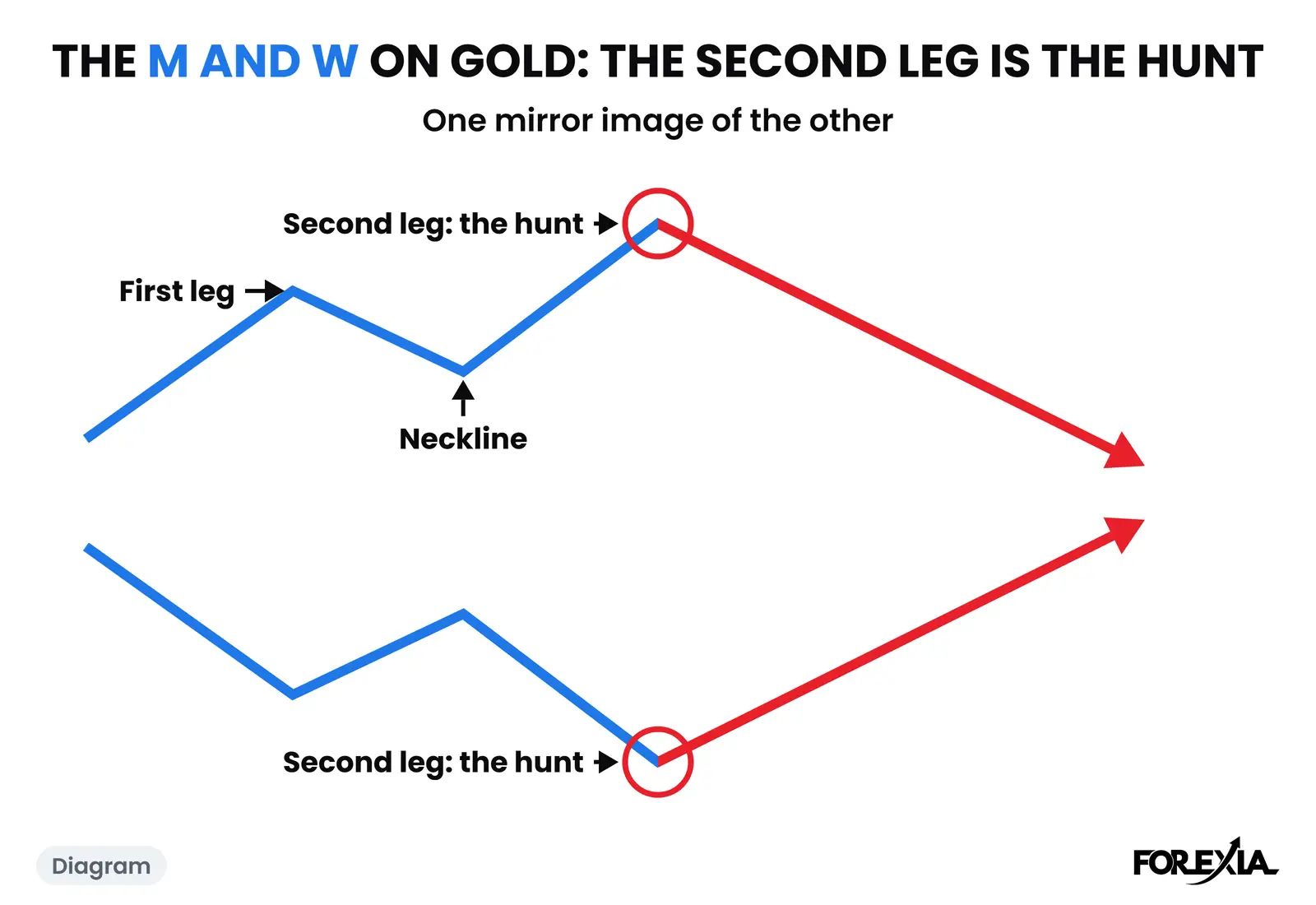
Four hunted the high and three the low, so it is not a one-way habit. The push was 9 to 27 pips past the range, which is small beside a gold day that averaged about 101 pips in this period, and the cost to anyone with a stop there is large. All seven were marked as a plain hunt of the range, with no first leg and neckline beyond it, so none is an M or a W.
The cleanest: Friday 28 August 2026, 186 pips
Asia left a 42-pip range, 4571.09 to 4612.95. At 10:00 New York a candle pushed 18 pips past the high, to 4630.84, the breakout the crowd buys. It reversed 186 pips to 4445.20 in 4 hours 30 minutes, through the whole Asian range. The 10:00 candle carried a Fed chair speech and the Nonfarm Payrolls benchmark revision, which the calendar lists as high impact, so the hunt fired on the minute of a known release.
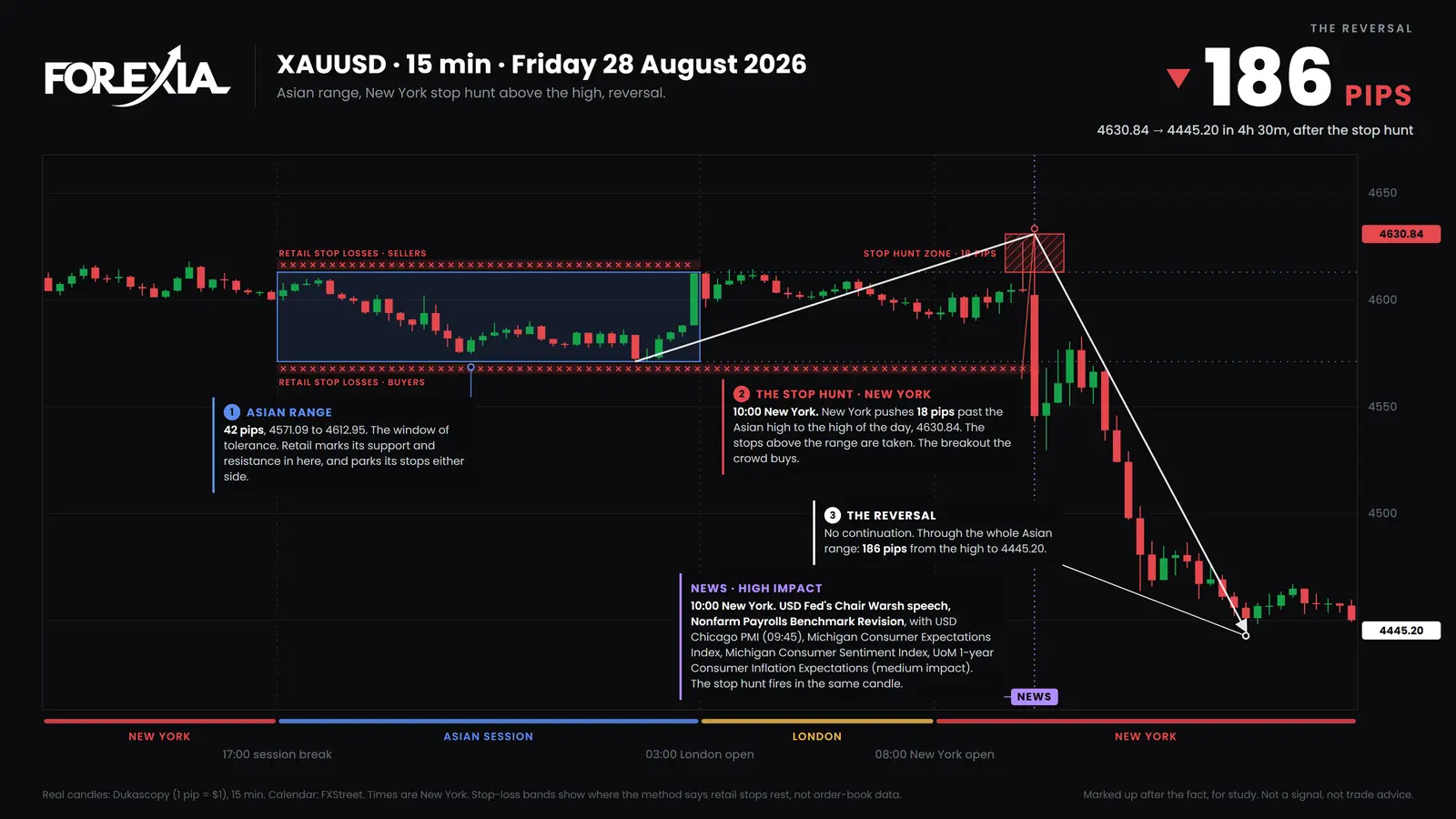
That day came in a week when the large speculators were crowded long gold: the reports counted on 18 and 25 August had them at an index of 93 and 98, and our gold COT page shows how that is read. A report counts positions and not stops, so we do not claim the two are linked.
How do you read a New York hunt on your own chart?
After the day, in four looks, none of which is a trade.
- The range. Mark the Asian range from the 17:00 session break to 03:00 New York. On these days it was 38 to 59 pips, roughly 40% to 60% of gold's average day of about 101 pips in this period.
- The extra levels. Note yesterday's high and low. On 1 May, 9 June and 17 July the hunt also went through the previous day's extreme, by 13, 10 and 10 pips.
- The close back. Look for the first 15-minute candle that closes back inside the range. On 7 April and 9 June it was the hunt's own candle.
- The release. Check the calendar for the hunt's candle, and for the hours before it. On 8 May Nonfarm Payrolls came at 08:30 and a medium-impact consumer sentiment release landed in the same candle as the hunt at 10:00, while on 9 June home sales came 15 minutes after the hunt.
This is a way of reading a day that has already happened. It does not say which day the next hunt will be.
A quiet one: Tuesday 7 April 2026, 111 pips
Asia left a 52-pip range, 4616.02 to 4667.61. At 10:00 a candle fell to 4607.34, 9 pips under the low, and closed at 4621.68, back inside on the same candle. No US release landed on it. By 15:45 gold was at 4718.47, 111 pips off the low, and the day ended at 4704.78.
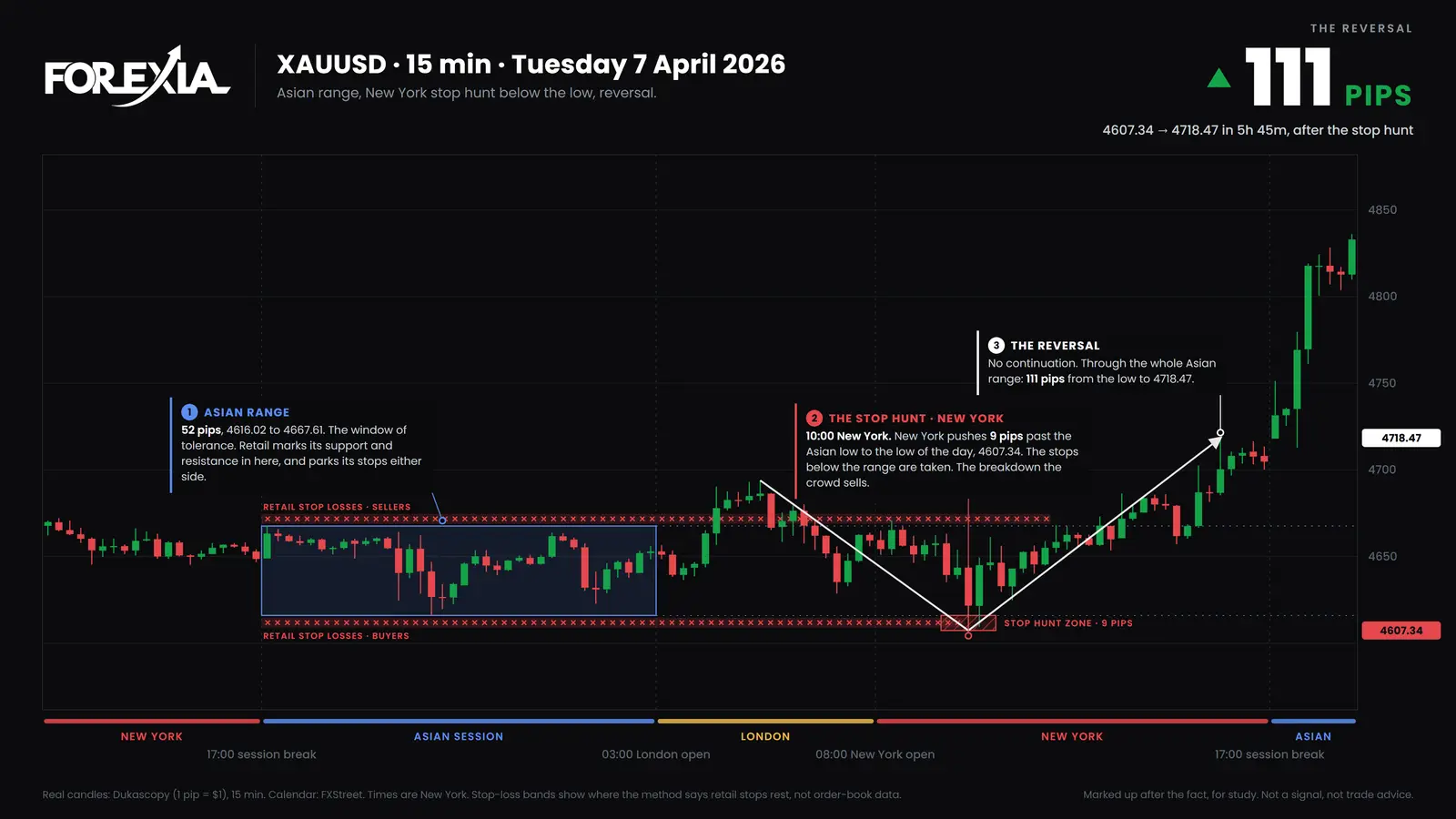
Here the hunt came with no scheduled release, so a release is not needed. Of the seven days, two had no medium or high-impact release lined up with the hunt, on 7 April and 20 August. On 20 August the push was the largest in the table, 27 pips under a 50-pip range at 08:00, and gold rose 90 pips to 4540.80 by 11:15.
When it stopped halfway: Friday 8 May 2026, 47 pips
Asia left a 59-pip range, 4675.65 to 4734.35, and closed near its top. At 10:00 a candle pushed 15 pips past the high, to 4749.24. Nonfarm Payrolls had come at 08:30, and a 29-pip candle printed on it. Gold fell to 4701.82 by 11:45, 47 pips and back inside the range, and no further. It never reached the far side at 4675.65.
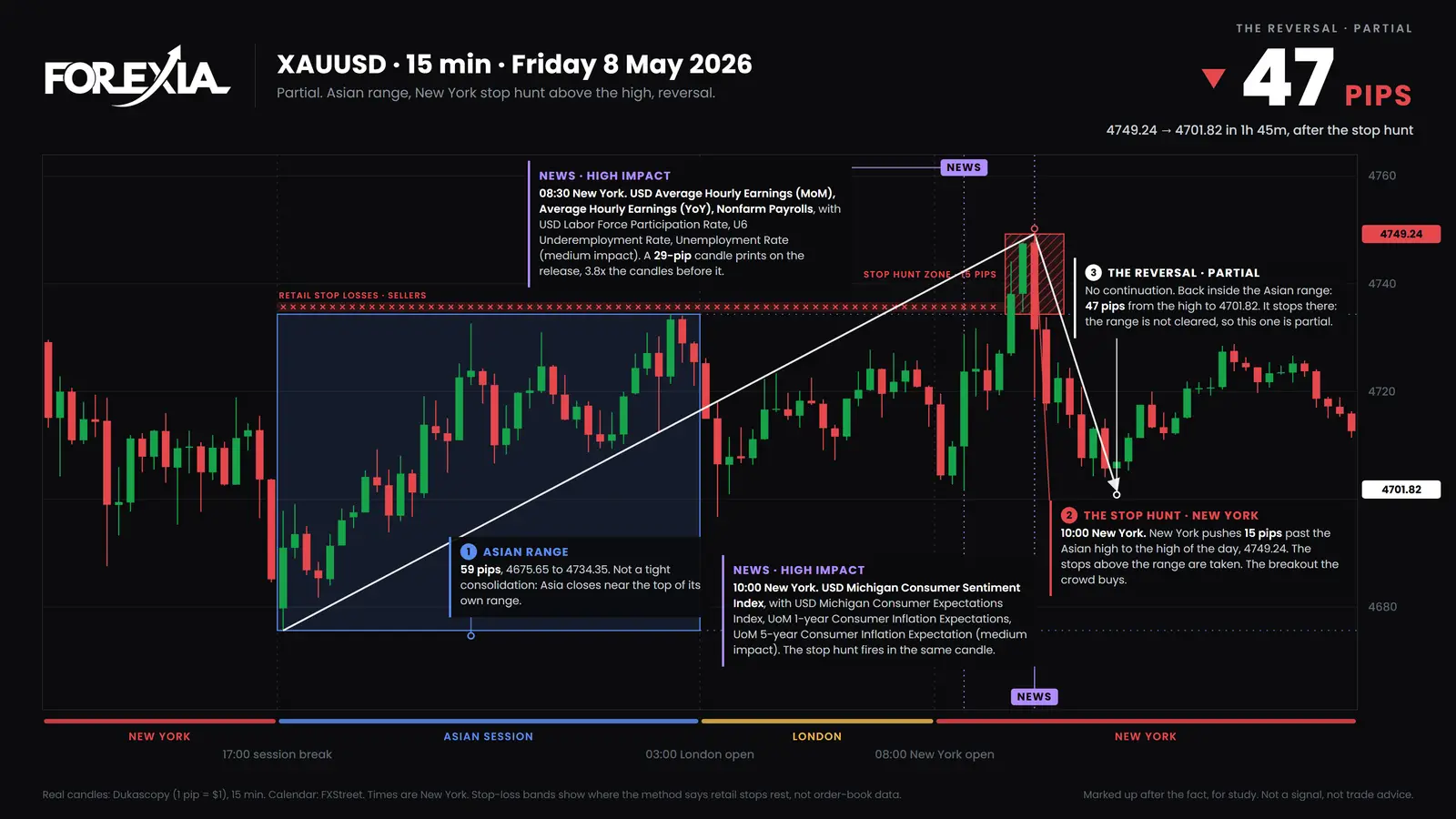
We grade a day textbook when the reversal clears the whole range. This one is partial: the structure printed and the reversal was small. Fri 1 May, the other partial, had a 24-pip push at 10:15 and a fall of 53 pips back to 4606.81. Two of seven were partial, and a hunt is not worth a trade just because it printed.
What do these days not show?
Quite a lot, and we say so.
- They are marked days, not every hunt. Every XAUUSD New York hunt we marked is here. Days where gold broke the range and kept going are not in the set, and the hub counts them: from 6 April to 1 October 2026, a candle closed back on 151 of 184 edges and previous-day highs and lows, and after 96 of those a later candle went past the furthest price anyway. On 23 July 2026 London closed under the Asian low at 03:00 and nothing closed back, and the sellers of the break were right.
- The numbers are measured after the fact. The 186 pips is from the hunt's extreme to the low of the move. No one entered at that extreme.
- They are not a method. We ran our setup on gold as a fixed rule with the real spread and costs, over 3,884 trades from 2012, and it lost between 0.089R and 0.146R a trade in every period. The stop hunt guide has the test and its limits.
From the three seats: retail sees the break of the night's range and buys it. The market maker, as we read it, sees stops to fill. The observer sees the close back after it has printed, and nothing before.
Course 3 of ForexiaPRO, Reverse Price Action, teaches the hunt and the close back step by step. For the same read in London, see the London open stop hunt, and for the New York session as a whole, the New York reversal.
Tools for this
Frequently asked questions
What time does gold hunt stops at the New York open?
On the seven days below the hunt's extreme printed between 08:00 and 10:15 New York time: 08:00 once, 09:00 once, 09:45 once, 10:00 three times and 10:15 once. Over 2021 to 2026 the busiest hours for a gold hunt were 08:00 (22%), 09:00 (21%) and 10:00 (14%).
How far does gold go after a New York stop hunt?
On these seven marked days, from 47 pips to 186 pips from the hunt's extreme to the day's far extreme. Five cleared the whole Asian range and two stopped inside it. The days were marked afterwards, so they say how far a hunt can go, not how far the next one will.
Is every New York break of the Asian range a stop hunt?
No. In our count of 184 edges of the Asian box and previous-day highs and lows from 6 April to 1 October 2026, a candle closed back on 151 by 17:00, and after 96 of those a later candle went past the furthest price anyway. A break that stays is a break, and on 23 July 2026 London closed under the Asian low and never came back.