Forex Research Archive: Every Test We Ran, Losses Included
Dylan Forexia6 min read
In brief: This archive lists every study of ours that has a page: what was tested, what it found after costs and what it does not prove. Most are losses. Our own setup, run as a fixed rule, lost in every period, and nineteen of twenty published strategies failed a mark written before the first run.
This forex research archive, a forex backtest results archive in one place, lists every test we have written up, in one place. Most of them are losses, and they come first in each line. Each row names what was tested, the result after costs and the limit that matters most, then links to the page where the sample, the dates and every caveat are printed.
The studies come in two kinds, and the archive marks which is which. A backtest runs a rule on past prices with costs and says whether it paid. A count asks how often something happened on real days, trades nothing and has no costs. A count is not a result, and a page that counts says so.
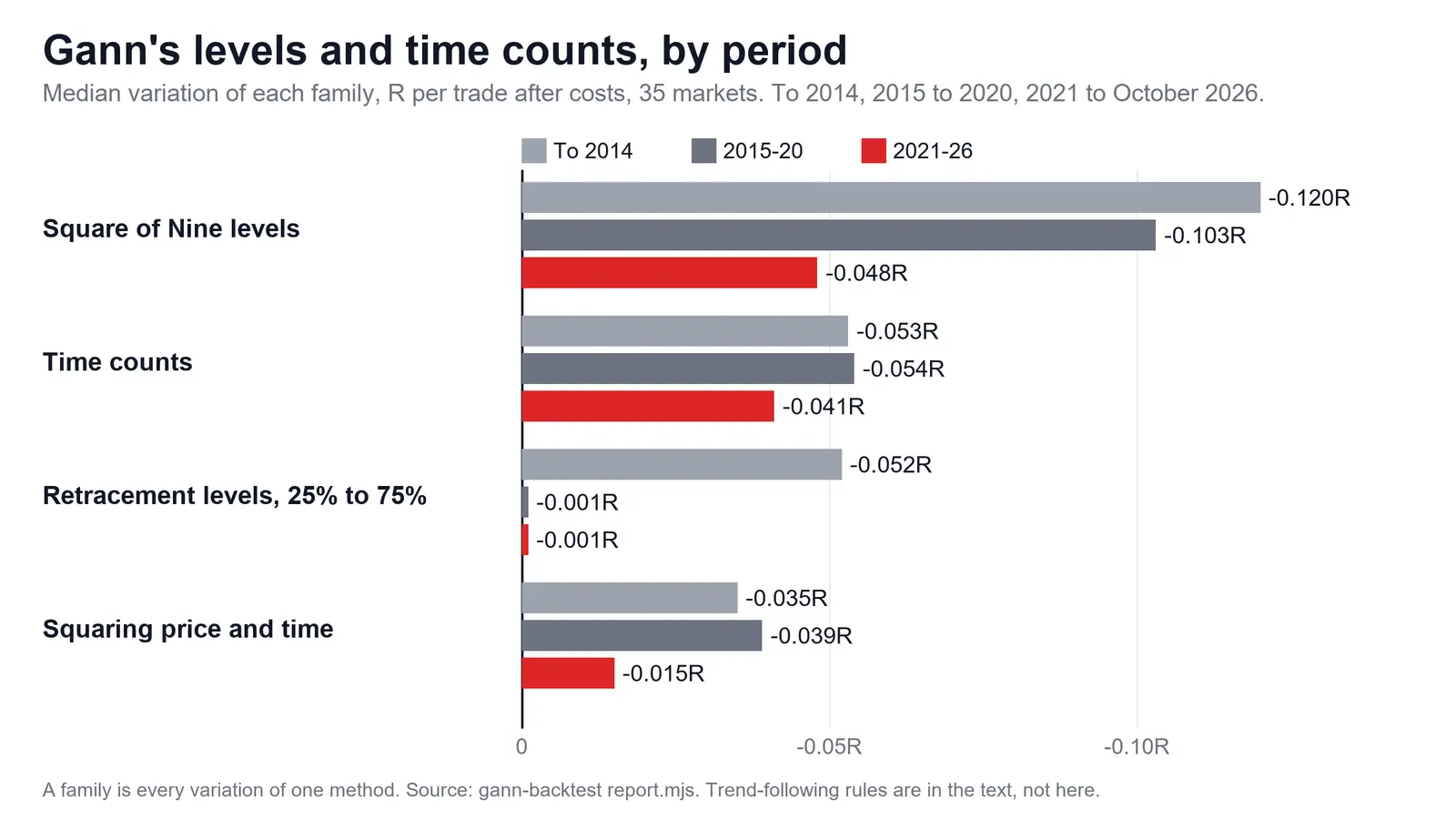
R is the amount risked on one trade, so -0.10R means losing a tenth of your risk, on average, each trade.
What are the backtests in the forex research archive, and what did they find?
These are the rules we ran, with their costs on every bar. Each result is as the page prints it, after the rerun of 11 November 2026.
| Study | What was tested | What it found | Main limit |
|---|---|---|---|
| Mechanical setup backtest, 2015 to 2026 | The setup we teach, run as a fixed rule on seven dollar majors and gold | Lost in every period: -0.104R a trade in 2015-20, -0.122R in 2021-24, -0.128R in 2025-26 | A program with no judgement, so it says nothing about a person |
| Liquidity sweep backtest | Trading against the hunt as a fixed rule, 2021 to 2026 | Every year lost, between -0.10R and -0.23R a trade | Hunts that keep going are much of the reason, and the program cannot know in advance which |
| Gold strategies tested | The setup, the London auction trade and Gann levels on XAUUSD | Buys and sells both lost in every period, though gold rose far over the sample | Trend following stayed above zero in a rising market, which is a different claim |
| Gann levels backtest | 2,177 variations of Square of Nine, the 50% level and time counts on 35 markets | Nothing held after costs, and turning points did not land on his numbers more often than on their neighbours | The 40 kept-back markets only saw the best three rules, frozen |
| Published trading strategies backtest | Twenty tests of sixteen published rules, with retail costs | None passed a mark written down first: one candidate, nineteen failed | Tests retail collection, not whether the pattern exists |
| Does the COT report work? | Positions of the large speculators, set against a three-year range, over 16 years | The crowd's reading did not work as a method taken with the crowd | Described in words here: its numbers and caveats are on its own page |
| Fading the crowd on a COT level hunt | The one slower idea, a hold of weeks against a crowded reading on a level hunt | The one result that did better than the rest, promising and not proven | The rule was chosen after seeing most of the data |
The two COT rows are the only ones where we print a positive figure, and each is printed with its caveats together on its own page.
What are the counts, and what did they find?
These count real days. They are candles, not trades, and they are on past days only.
| Study | What was counted | What it found |
|---|---|---|
| How often a liquidity sweep reverses | Levels swept on seven dollar majors and gold, 6 April to 1 October 2026 | 368 of 1,601 levels reversed by a strict rule |
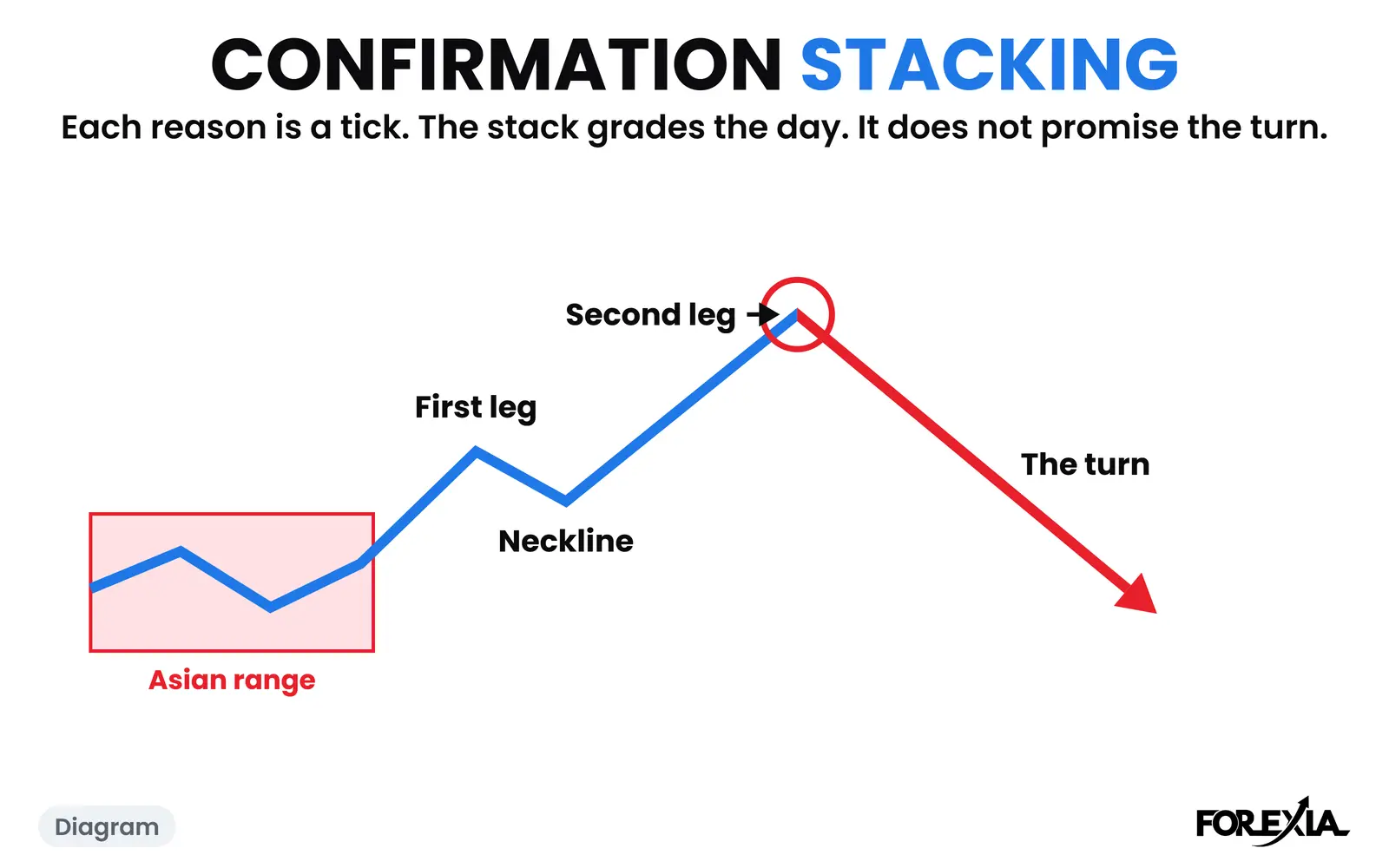
| London open fakeout | Market-days where the first edge of the Asian range was taken | 121 of 958 market-days ended beyond the other edge |
| New York against London | Market-days where New York went past London's extreme and closed back inside the Asian range | 91 of 458 market-days |
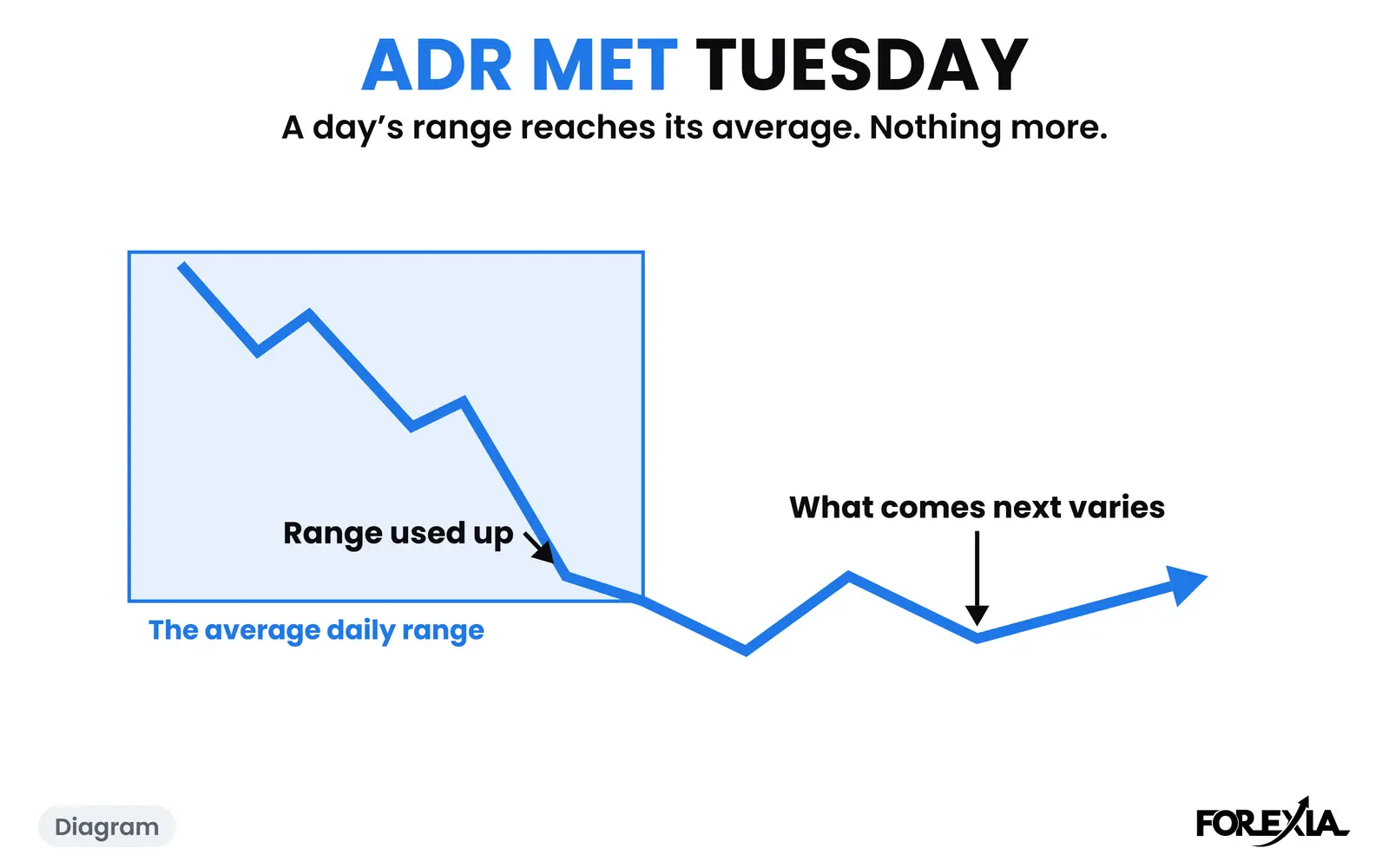
| Average range by weekday | The size of each weekday's range | Wednesday and Thursday ran largest. This is about size only, not direction |
| Double top failure rate | 983 double tops and double bottoms on 15-minute candles | 680 never closed through the neckline that day or went past the peak first, and 104 of the 303 that did traded back past the peak |
A count that says "one in four reversed" does not say a trade pays. The same sample is also in the backtest rows above, and the backtests are where costs enter.
What patterns appear across all of them?
Four things repeat, and they are the reason we print the failures.
The pattern is often there and the money is not. Why forex strategies fail backtests takes the cost ladder from these studies in one place: the setup was about -0.03R a trade with no costs and about -0.16R with spread and commission.
A chart chosen afterwards flatters a rule. A marked-up day is picked once price has reversed. The same program lost on days that never became a markup, and there were many more of those.
A slice that worked rarely worked again. A market, hour or weekday that made money in one period nearly always lost in the next.
Nothing here was traded live. Every result is past data on one source of candles and costs.
How should you read an entry in this archive?
Start with the sample and the dates. Then the costs, which are said on every page. Then the limit. A result with no limit stated is a claim, and we do not print those.
If a study of ours is one a trader might act on, the right next step is not to follow it. It is to keep a journal of what you actually do, take small steps and test your own version on days you have not seen. The archive shows where our own versions broke so that yours need not break in the same place.
What is not in the archive?
Three things.
- Signals. The free channel's record of signals, losses included, is on the case-file record. It is a ledger of what was sent, not a test.
- Course material. The rules, entries, stops and targets of the ForexiaPRO courses are not published, and none of the studies here prints them.
- Studies not yet written up. A test appears here when it has a page with its sample, costs and limits, and not before.
How does this archive change?
When a study is added, it appears in the table with the date it was written. When a rerun gives a worse figure, the page prints the worse figure and says what moved. The studies above were rerun on 11 November 2026 on candles that run to the close of Friday 2 October 2026. Where a figure changed, the page's own note says so.
This archive was written on 13 November 2026 as an index. It holds no figure that is not printed on the page it links, and no new test was run for it. For the reading of the stop hunt that these tests examine, the glossary has fade the crowd, and how to spot reverse price action shows what a hunt looks like on a finished day. The full set sits under the research page.
Frequently asked questions
Where can I see forex backtest results that include losses?
This archive lists every study we have published, with the result after costs and the main limit of each. Most of them are losses, and they are printed first in the sentence, not last. Each entry links to its own page, where the sample, dates, costs and caveats are.
Do you publish the strategies that worked?
We publish what the tests found. One slower idea, trading against a crowded COT reading on a level hunt, did better than the rest and is described on its own page as promising and not proven. Nothing here is a signal, and nothing was traded live.
Are the results in R or in percent?
R, the amount risked on one trade, where a test has a stop. Tests with no stop, such as holding a pair for a few hours or a month, are stated in percent a year, because no R exists for them. Counts of days are plain counts.
Why are some studies counts and not backtests?
A count asks how often something happened on real days, such as how often a swept level reversed. It does not trade anything, has no costs and is not a result. A backtest asks whether a rule paid after costs. The archive marks which is which.
Will the archive be updated?
Yes. A new study is added here with its date, and a finding that gets worse on a rerun is printed as it now stands. The dated note on each page says what changed.